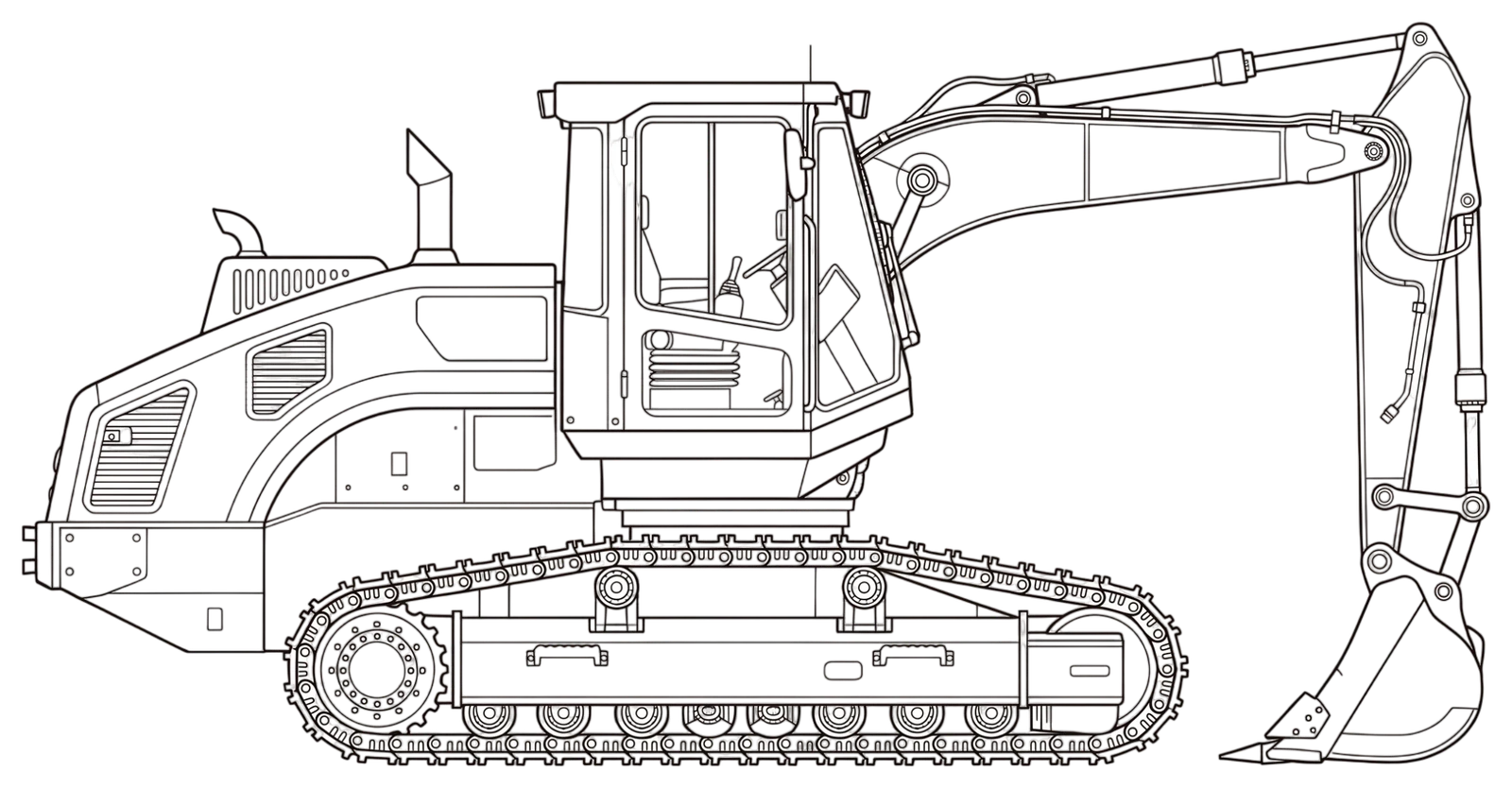
Informazioni su · Hyundai HX380Panoramica
The Hyundai HX380 is a large crawler excavator occupying the upper tier of the construction and heavy civil earthmoving segment. Its operating weight and bucket capacity position it firmly in the 35-to-40-tonne class, where machines are selected for high-cycle productivity rather than confined-site manoeuvrability. Hyundai's HX series replaced the earlier R-series line and carries forward a reputation for competitive cycle times and straightforward serviceability. The HX380 competes directly on specifications with other manufacturers' flagship large excavators in the same weight band.
Applicazioni tipicheDove viene utilizzata questa macchina
Machines of this class are deployed on large-scale earthmoving, bulk excavation, quarry face work, heavy demolition preparation, and mass-haul loading of rigid or articulated dump trucks. The HX380's digging reach and bucket capacity make it suited to deep trench excavation, levee and dam construction, and port or infrastructure groundworks where high material throughput per hour is a primary requirement. Smaller or mid-range excavators are typically substituted on sites where access constraints or lower daily volume targets do not justify a machine of this size.
Ispezione del mercato dell'usatoCosa controllare prima dell'acquisto
Before committing to any large crawler excavator of this class, commission a full hydraulic pressure and flow test across all circuits, including the swing motor and travel drives, as pressure deficiencies in high-hour machines often indicate pump or control-valve wear that is not visible on inspection alone. Examine the undercarriage closely: measure track pad thickness, sprocket tooth profile, and idler condition, because undercarriage replacement on a machine this size represents a significant portion of reconditioning cost and the wear state directly affects near-term operating economics. Request a complete service history and cross-reference recorded hours against physical wear indicators on the cab interior, control levers, and boom-foot bushings. On HX-series machines specifically, inspect the hydraulic oil cooler and its mounting for impact damage or core blockage, as cooling efficiency is reported as a maintenance-sensitive area on larger Hyundai excavators. Verify that all OBD or telematics data is accessible and that any fleet management lock codes are cleared prior to transfer of ownership. Structural welds on the boom and dipper should be inspected with dye-penetrant or equivalent methods if the machine has worked in rock-breaking or demolition applications, where fatigue cracking initiates earliest.
Mercato attualePosizionamento di prezzo
In its weight class the HX380 is cross-shopped most directly against the Komatsu PC360 and PC390, the Caterpillar 374, the Volvo EC380, and the Liebherr R 936. Relative to the Komatsu PC360 the HX380 carries a higher operating weight and nominally larger rated bucket capacity, while the Caterpillar 374 sits slightly above it in operating weight and is often perceived as the benchmark for residual value retention in this segment. The Volvo EC380 competes closely on operating weight and is frequently compared on fuel consumption credentials. Within the HX380's own price band, the attributes that move an individual machine higher or lower include recorded service hours, single-owner versus fleet-managed provenance, full service history documentation, the presence of a factory quick-coupler or dedicated attachments such as a hydraulic thumb or secondary hydraulic circuit, undercarriage wear percentage, and overall structural and cosmetic condition. Machines configured with a long-reach boom or with verified low hours on a recent engine or hydraulic overhaul will typically command a stronger position within the band.