Acerca de · JCB JS175WResumen
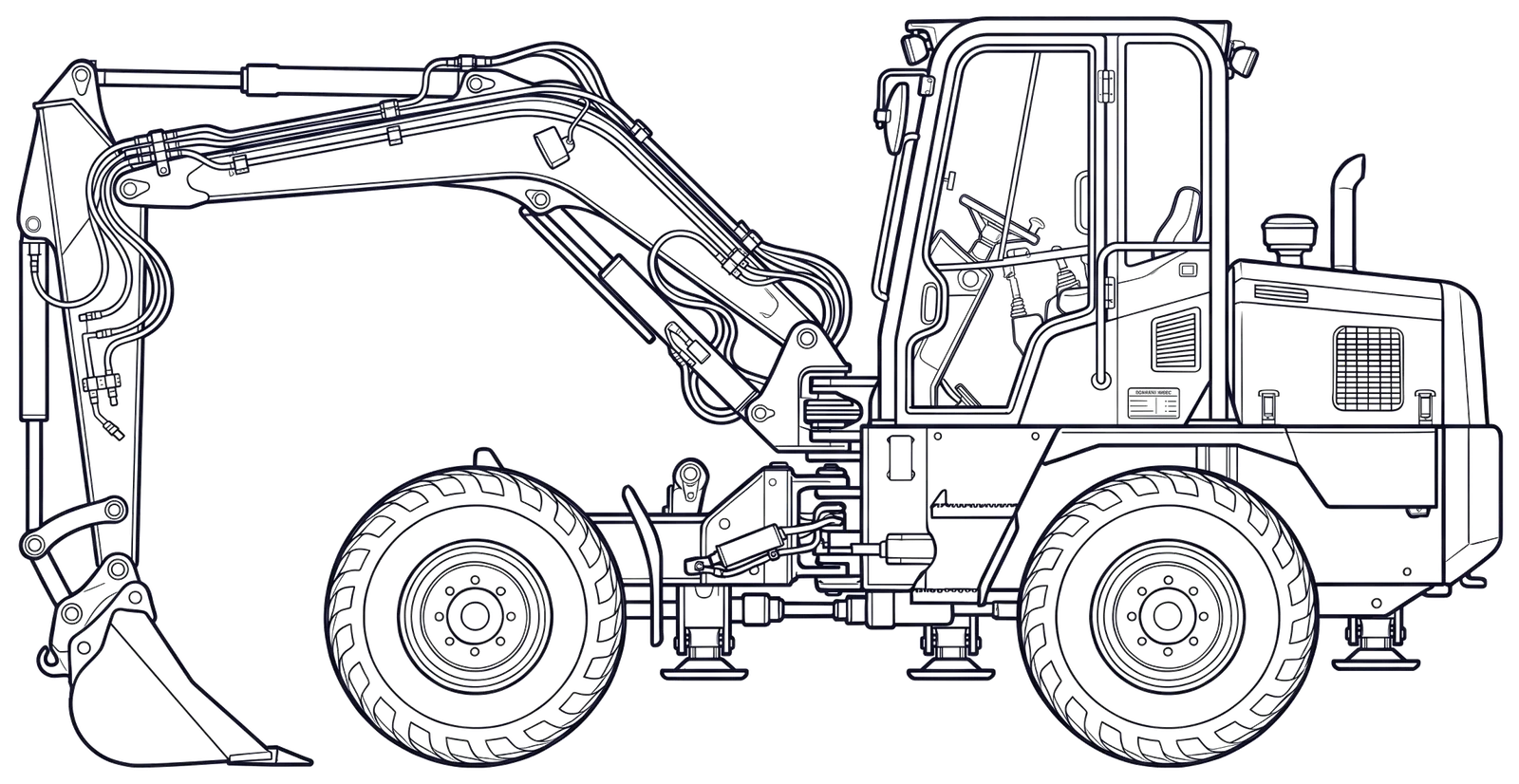
The JCB JS175W is a 17.5-tonne class wheeled excavator designed for work in environments where a tracked undercarriage would be impractical or damaging. Built around a conventional upper-structure rotation system mounted on a four-wheel drive axle arrangement, it delivers the digging performance associated with the 18-tonne excavator segment while retaining the road mobility and site-to-site self-propulsion that defines the wheeled excavator class. It occupies a mid-size position within the wheeled excavator segment, above compact units and below the heavier 20-plus-tonne wheeled machines used in major civil infrastructure work.
Aplicaciones típicasDónde se utiliza esta máquina
The JS175W is typically deployed on urban construction sites, roadworks, drainage and utilities projects, and maintenance contracts where a machine must move between locations under its own power without a low-loader. Its wheeled configuration makes it well suited to working on finished or semi-finished surfaces such as asphalt and concrete where track damage is a concern. The class is also commonly used in quarry ancillary work, agricultural drainage, and canal or waterway maintenance where access routes demand rubber-tyred travel.
Inspección del mercado de segunda manoQué hay que comprobar antes de comprar
Before committing to purchase, inspect the slew ring for play and uneven wear, as replacement is a significant undertaking on any machine in this class. Check all four tyres for tread depth, sidewall cracking, and any signs of bead damage, given that tyres represent a material cost item on wheeled excavators that tracked machines do not carry. Examine the outrigger pads, cylinders, and pivot points for corrosion, weld repairs, and seal weeping. Review hydraulic hose routing along the boom and dipper for chafing or UV degradation. Confirm that all auxiliary hydraulic circuits function correctly through their full pressure and flow range. Request a full service history and cross-reference stamped intervals against the hour meter reading. On wheeled excavators, axle differential and brake condition should be assessed by a competent technician, as these components are not present on tracked equivalents and are sometimes overlooked during pre-purchase inspection. Finally, verify that all road-legal equipment, including mirrors, lights, and any required slow-vehicle signage mounts, is present and functional if the machine is intended for highway self-propulsion.
Mercado actualPosición de precios
Within the 17-to-18-tonne wheeled excavator class the JS175W is cross-shopped primarily against the Volvo EW180, the Liebherr A914, and the Caterpillar M318, all of which occupy broadly the same payload and digging-force band. The JCB unit is generally noted for its cab layout and service accessibility relative to some European competitors, while the Volvo EW180 sits at a slightly higher weight class and the Liebherr A914 is frequently specified with more extensive factory attachment options. Within the used market, the attributes that move a machine up or down within its price band are engine hours, service history documentation, tyre condition and remaining tread life, the presence of a quick-hitch system, the number and specification of hydraulic auxiliary circuits, outrigger condition, and overall structural integrity of the boom and dipper. Machines with full dealer-stamp service records and original factory attachments consistently attract stronger buyer interest than equivalent-hour units lacking documentation.