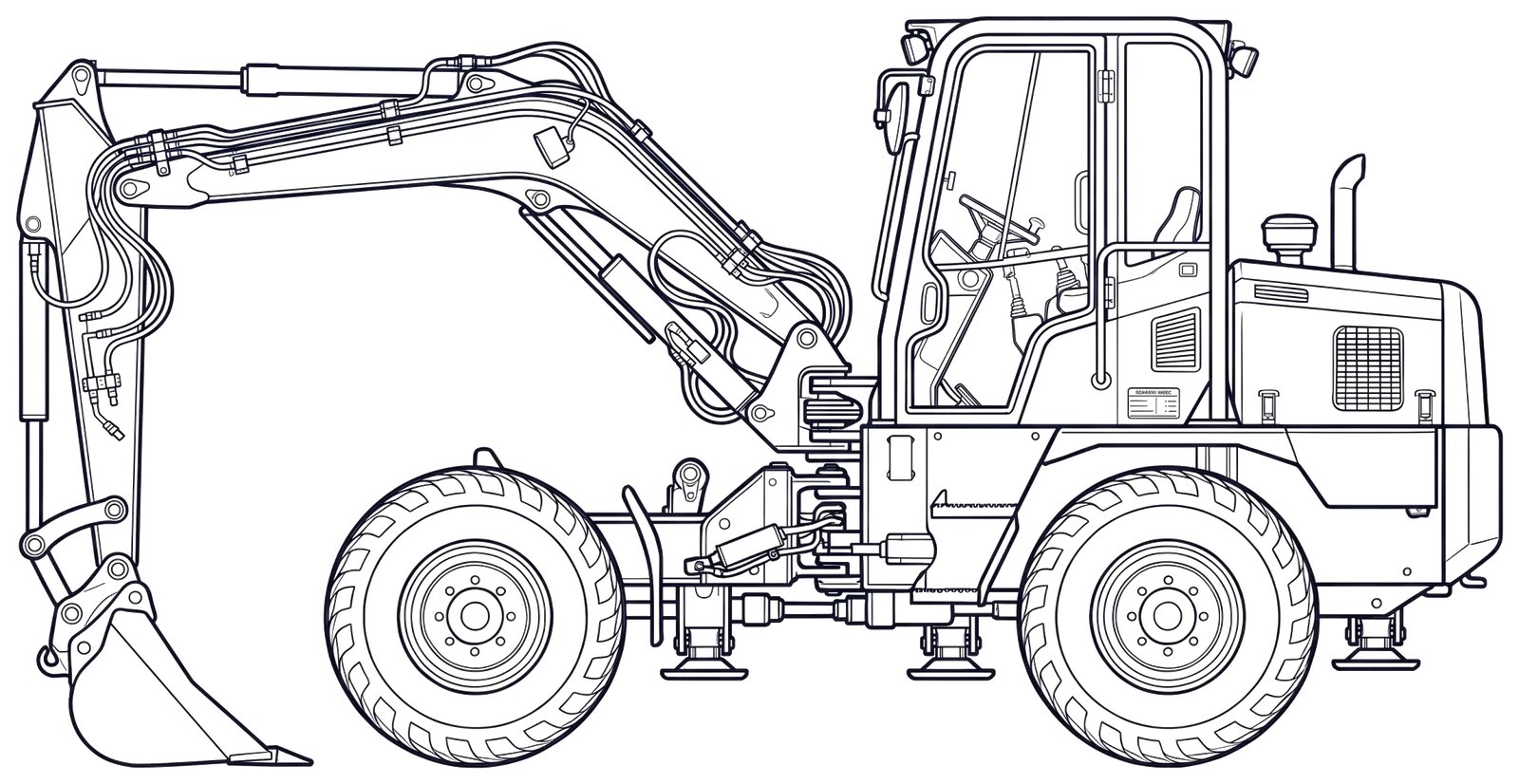
About · Doosan DX190WOverview
The Doosan DX190W is a wheeled excavator in the 19-tonne class, rated at an operating weight of 19,700 kg and powered by an engine producing 174 hp. With a bucket capacity of 0.93 m³, it sits at the productive end of the mid-range wheeled excavator segment, balancing road mobility with meaningful digging and lifting capability. Wheeled excavators in this class are purpose-built for work cycles that require frequent repositioning between sites or along linear infrastructure corridors without the need for a transport trailer.
Typical applicationsWhere this machine is used
Machines of this type are commonly deployed on road construction and maintenance, utility trenching, drainage works, and urban civil projects where rubber-tyred travel preserves road surfaces and allows rapid on-road transit between work faces. The 19-tonne operating weight and 0.93 m³ bucket capacity make the DX190W well suited to medium-volume earthmoving, pipe-laying support, and mixed-material excavation in confined or traffic-adjacent environments. Outrigger-equipped configurations extend the machine's utility to demolition assistance, material handling with grapples, and slope work requiring a stabilised platform.
Used-market inspectionWhat to check before buying
Inspection of a used wheeled excavator in this class should begin with a full review of service records to verify oil-change intervals and any component replacements. Tyre condition is a primary cost variable for wheeled machines and should be assessed for tread depth, sidewall cracking, and compatibility with the intended work surface. The slewing ring should be checked for play and abnormal noise, and all hydraulic lines, cylinders, and quick-coupler circuitry should be inspected for leaks and wear at connection points. On road-mobile machines, the travel drive, axles, and steering system deserve specific attention, including a test drive to confirm smooth engagement and straight tracking. Buyers should confirm that all outrigger cylinders extend and retract evenly and that pad contact is solid and stable. A machine with a documented attachment history and matching hydraulic flow records for installed tools carries measurably lower configuration risk than one with undocumented modifications.
Current marketPrice position
Within the 18-to-21-tonne wheeled excavator class, the DX190W is regularly cross-shopped against the Liebherr A918 and the Volvo EW180. The Liebherr A918 is a close weight-class rival with a strong European service network and a reputation for refined hydraulics, appealing to buyers who prioritise attachment versatility and dealer proximity. The Volvo EW180 sits at a comparable power and weight level and competes directly on road-mobility and operator-environment grounds. The DX190W distinguishes itself through its 174 hp output and 19,700 kg operating weight, which together position it toward the higher end of the sub-20-tonne bracket for tractive effort and stability. Within the used market, the attributes that move a specific unit within its price band are accumulated service hours, full service history documentation, configuration, whether the machine carries a two- or four-piece boom, the presence and condition of a quick coupler, and the quality and breadth of the attachment package. Overall mechanical condition, tyre wear grade, and remaining undercarriage life on the slewing ring and travel drives are additional value determinants.