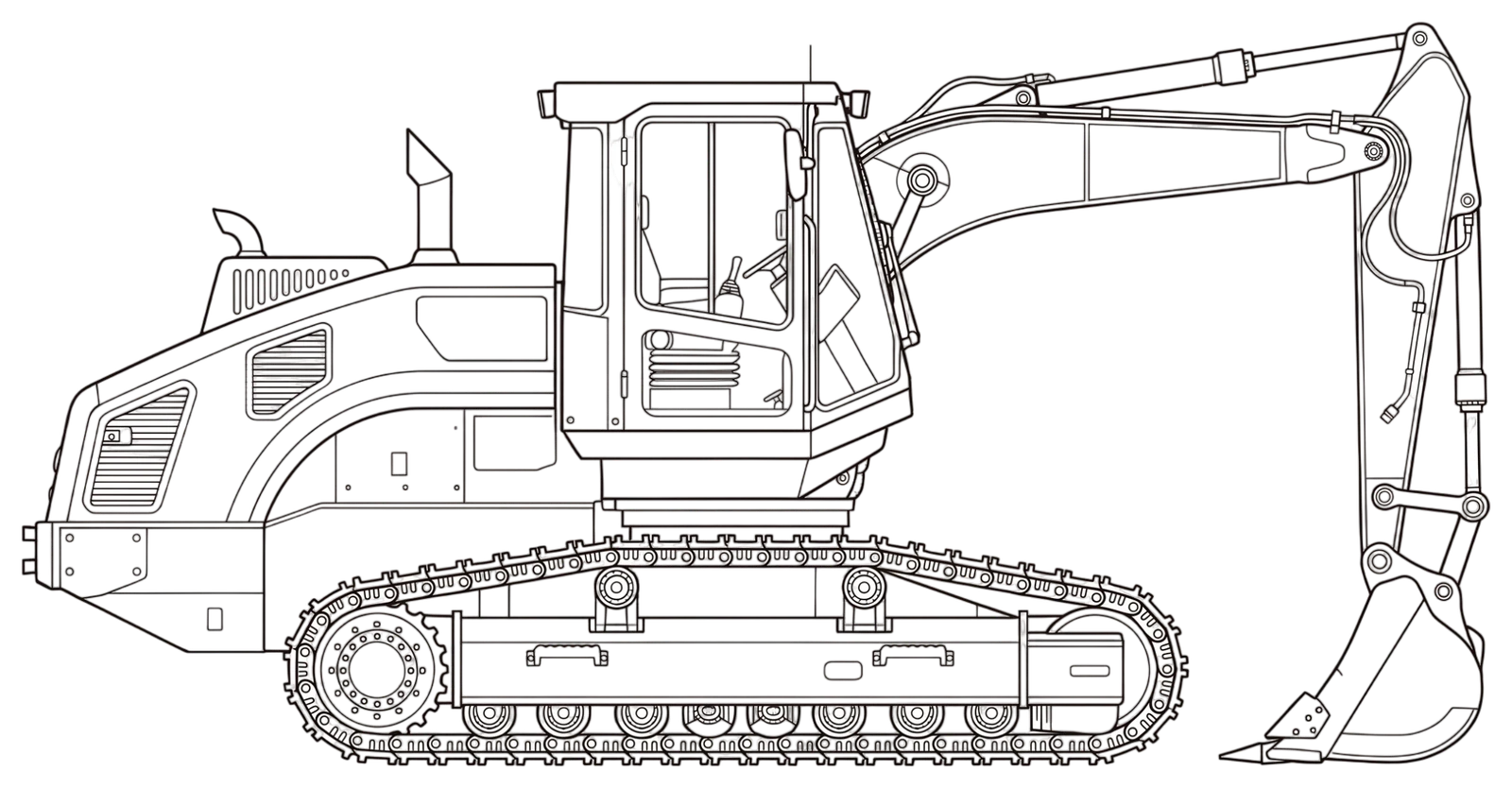
About · Caterpillar 312Overview
The Caterpillar 312 is a conventional-tail-swing hydraulic excavator positioned in the 10- to 13-tonne compact-to-mid class, a segment that balances reach and lift capacity against transport weight and site footprint. Built on Caterpillar's proven undercarriage and hydraulic architecture, the 312 is engineered for contractors who require a versatile, road-transportable machine without moving up to a full-size excavator. It represents one of the most widely distributed models in the Cat excavator line, giving it strong parts availability and broad technician familiarity across markets.
Typical applicationsWhere this machine is used
The 312 class is well suited to general civil earthworks, drainage and utility trenching, road-base preparation, and site clearance where a machine must work productively in confined or weight-restricted environments. Its lift and reach envelope supports foundation excavation for light commercial and residential structures, as well as landscaping and pipeline installation work. The class also sees regular deployment on municipal infrastructure projects where transport between sites is frequent and a compact footprint is operationally necessary.
Used-market inspectionWhat to check before buying
Inspecting a used 312 should begin with the undercarriage, as track chain stretch, sprocket wear, and pad condition are the most capital-intensive items to address on any machine in this class. Buyers should request a full service history and verify that hydraulic hoses, swing-bearing play, and boom-arm pin wear are within acceptable limits. Confirm that any attachments offered with the machine are genuinely compatible and that coupling systems are in working order. A pre-purchase inspection by an independent qualified technician or through a Cat dealer certified inspection program is advisable, particularly for machines where service records are incomplete. Checking that the telematics or hour-meter readings are consistent across documentation and the machine display is a basic but critical step before purchase.
Current marketPrice position
In its class the Caterpillar 312 is cross-shopped primarily against the Komatsu PC130 and Volvo EC140, both of which occupy a similar operating-weight band. The 312 is typically preferred where an established Cat dealer network and Cat parts commonality are priorities for a fleet operator, while the Komatsu and Volvo alternatives may be selected on the basis of differing hydraulic flow characteristics or operator-cabin preference. Within the 312's own price band, the principal attributes that move a unit higher or lower are total recorded hours, undercarriage wear, configuration, and attachment inventory. A machine fitted with a quick-coupler, a second auxiliary hydraulic circuit, and a documented service history will sit at the stronger end of the range, while high hours, worn track pads, or an incomplete service record will pull valuation toward the lower end. Blade-equipped variants for grading applications also command differentiation from bucket-only configurations.