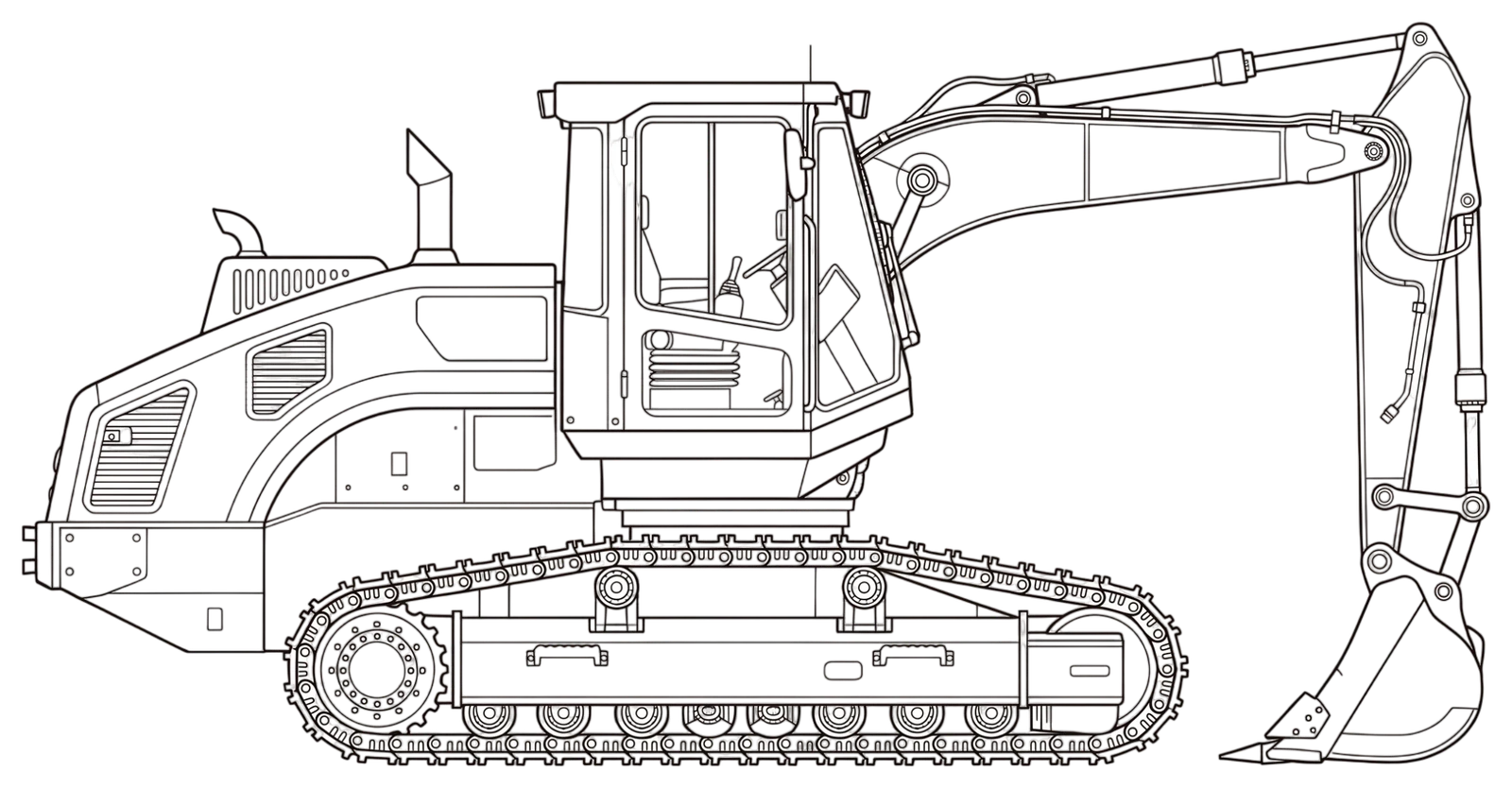
About · Hitachi EX120Overview
The Hitachi EX120 is a conventional tail-swing hydraulic excavator in the 12-tonne class, producing 81 hp and carrying a 0.5 m3 bucket. At an operating weight of 11,793 kg it occupies the upper end of the midi segment, where machine mass and digging geometry suit structured civil and groundworks applications. The model represents Hitachi's established approach to this weight class: robust undercarriage design and a straightforward hydraulic layout oriented toward reliability and serviceability.
Typical applicationsWhere this machine is used
Machines in this weight and bucket-capacity class are routinely deployed on drainage installation, foundation excavation, road sub-base preparation, and pipeline trenching. The 0.5 m3 bucket suits bulk dig cycles where a compact footprint is still required, making the EX120 practical on constrained urban sites as well as open groundworks. Secondary applications include site clearance, material loading into trucks, and general earthmoving where a full-size machine would be disproportionate.
Used-market inspectionWhat to check before buying
Inspection priority for any machine in this class should begin with the undercarriage: track shoes, rollers, idlers, and sprockets represent a significant portion of ownership cost and their condition directly reflects how the machine has been used. Hydraulic cylinders should be checked for seal leaks and rod scoring, and hose routing should be examined for chafing or unauthorized repairs. The swing bearing is a focal point on excavators of this weight, as wear there affects cycle efficiency and repair complexity. Engine bay inspection should confirm coolant and oil condition, turbo shaft play, and the integrity of air filtration. Structural inspection of the boom, dipper arm, and attachment pin bores matters particularly on machines with high utilization or known use in rock or demolition work. Service history documentation, even partial, adds confidence that scheduled maintenance has been observed; absence of records does not disqualify a unit but shifts inspection emphasis toward component wear measurement.
Current marketPrice position
The EX120 competes directly with the Caterpillar 311 and the Mecalac 10MCR in cross-shop evaluations for this class. Against the Caterpillar 311, buyers weigh Hitachi's parts-network reach and hydraulic system characteristics; the Cat carries comparable power output positioning and is evaluated side by side on undercarriage specification and service interval access. The Mecalac 10MCR introduces a rotating superstructure format suited to road-restricted sites, making it a divergent choice when site geometry drives the decision rather than raw dig performance. Within the EX120's own price band, the attributes that move a unit are accumulated hours, general mechanical condition, undercarriage wear, the presence or absence of a quick-coupler, attachment inventory, and whether the machine has been operated in abrasive or corrosive environments. Configuration details such as blade fitment, counterweight specification, and cab options also influence where a given unit sits relative to others in its class.