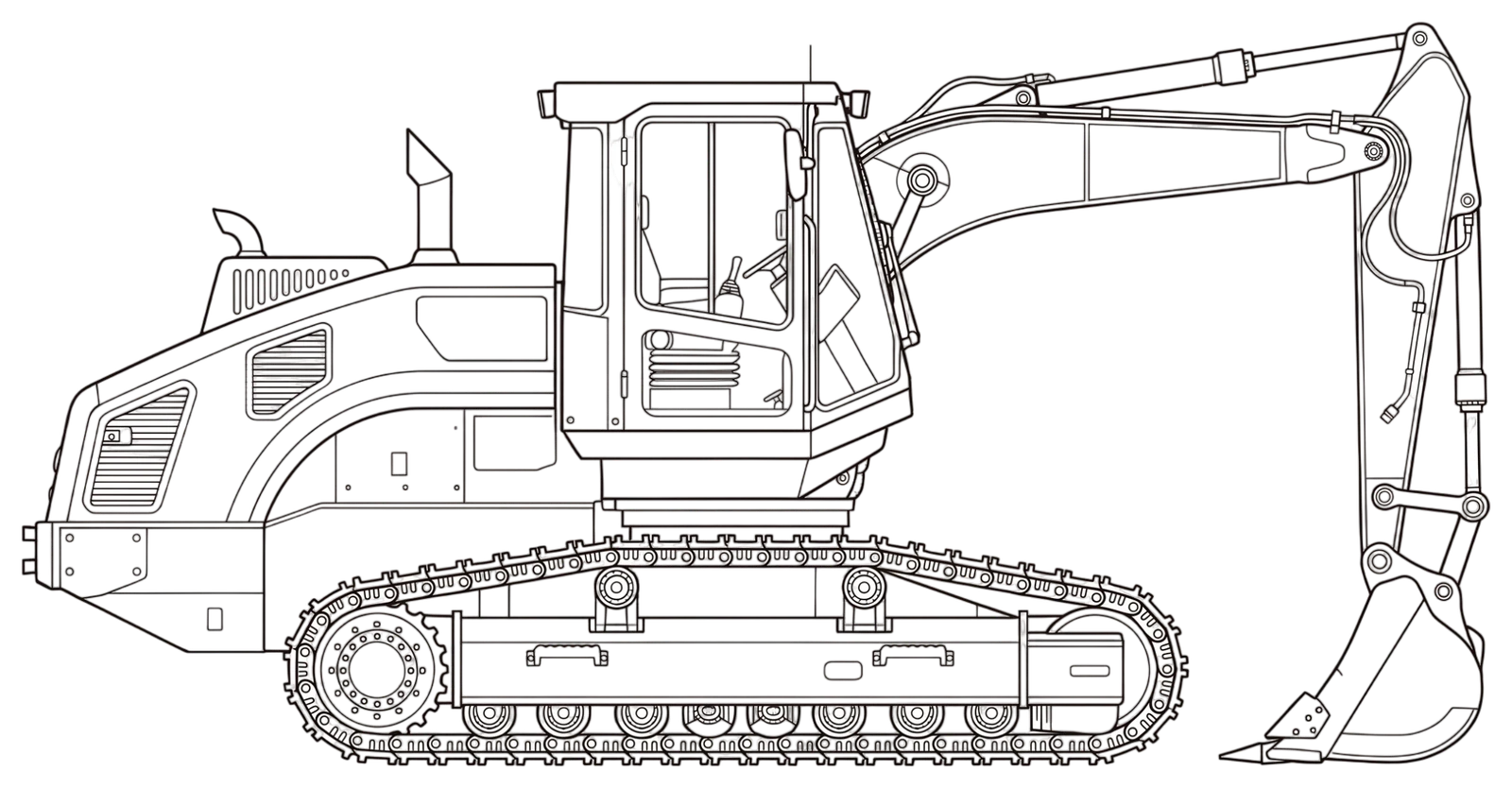
About · Volvo ECR355Overview
The Volvo ECR355 is a reduced-swing-radius crawler excavator positioned in the upper-mid to heavy excavation class, designed to deliver the digging force and reach of a full-size machine while maintaining a tighter tail-swing envelope suited to confined working environments. Its reduced-swing configuration distinguishes it from conventional long-tail counterparts of comparable operating weight, giving operators more flexibility on restricted jobsites without sacrificing productive capacity. The ECR355 sits within Volvo's established EC/ECR lineage, sharing platform engineering with the broader 30-to-40-tonne class that the manufacturer has supplied to infrastructure and civil contractors globally.
Typical applicationsWhere this machine is used
Machines of this class are typically deployed on urban civil works, road construction, pipeline laying, and foundation excavation where both reach and restricted site clearance are operational requirements. The reduced tail-swing geometry makes the ECR355 particularly suited to work alongside road traffic, within utility corridors, or in built-up areas where a conventional counterweight would create a hazard or regulatory issue. Secondary applications include bulk earthmoving on larger open sites where contractors favour a single versatile machine capable of handling both confined and open phases of a project.
Used-market inspectionWhat to check before buying
Before purchasing a used ECR355 or any machine of this class, commission a full undercarriage inspection given that track components represent a substantial proportion of restoration cost on a 30-to-40-tonne crawler. Examine the boom, arm, and bucket cylinder seals for weeping or active leaks, and verify that all auxiliary hydraulic circuits are functional if the machine is intended for use with a breaker, shear, or other tool carrier. Request full service documentation and cross-reference intervals against the hour meter reading, paying particular attention to final-drive oil changes and swing-bearing condition, both of which are common deferred-maintenance items on heavily utilised machines. Inspect the cab for ROPS/FOPS certification validity in the target operating jurisdiction, and confirm that any fitted quick-coupler meets current safety standards. A pre-purchase inspection by an independent engineer or an authorised Volvo service centre is advisable for machines with limited or absent service history.
Current marketPrice position
Within the 30-to-40-tonne reduced-swing class the ECR355 is cross-shopped most directly against the Komatsu PC360LC, Liebherr R 936, Hitachi ZX350LC, and Caterpillar 336 in conventional form, though buyers weighing a compact-tail requirement will note that not all those competitors offer a purpose-built reduced-swing variant at equivalent operating weight. The ECR355's specific differentiator is its combination of heavy-class digging capability with a tail-swing radius that reduces site clearance demands, a specification that commands attention from contractors who would otherwise need to rent additional traffic management or obtain special permits. Within the used market, the attributes that move a unit within its price band are documented service history and hour meter reading, overall undercarriage wear and remaining track life, the presence and condition of auxiliary hydraulics and quick-coupler systems, boom and arm configuration, the availability of original buckets or specialist attachments, and geographic provenance affecting corrosion exposure and regulatory compliance. Machines with comprehensive dealer or OEM service records, lower accumulated hours, and matched attachments consistently occupy the stronger end of the value range for this model.